.svg "logo (1)")









An argument for better AI strategies in banking
The biggest problem with AI in commercial lending isn't that it's moving too fast. It's that it's solving the wrong problem. I mean, commercial banking has never had a shortage of ways to crunch numbers faster, we just sometimes have gone fast in ways that have not always added value.
We have ratios, spreads, ticklers, covenants, risk ratings, exception reports, industry benchmarks, peer comparisons, cash flow worksheets, and enough PDFs to test the patience of a saint.
The problem was not that bankers lacked data. The problem was that too much of the old analysis told us what we already suspected.
That is the real failure of “elevator analysis” back in the day.
Data went in. Ratios came out. A credit memo got built. The package looked disciplined. But the conclusion was often obvious: leverage is high, liquidity is thin, cash flow coverage is tight, margins are down, receivables are stretched, or the borrower is fine because the last three years looked fine.
What commercial lenders have always needed is better insight — not simply a faster way to produce a credit memo.
That distinction matters even more today.
Because the industry risks repeating the same mistake with AI.
Why Elevator Analysis Failed – And What AI Strategies Should Learn From It
The old model of financial spreading and credit analysis was built around historical financial statements. That made sense for a long time. Bankers needed a consistent way to normalize borrower financials, calculate ratios, and support credit decisions.
But consistency is not the same thing as insight.
That matters because commercial credit risk rarely introduces itself politely.
A borrower does not usually deteriorate because last year’s current ratio was 1.18 instead of 1.25. The problem is more often hiding in the movement: customer concentration, shrinking backlog, deposit behavior, collateral pressure, changing industry conditions, or a management team that is quietly out of answers.
That is why elevator analysis became frustrating. It produced a neat package, but too often the “analysis” stopped at surface-level conclusions. The borrower is leveraged. The borrower is profitable. Inventory is up. Margins are down.
Fine. Now what?
The best bankers already knew the obvious. They needed help finding the non-obvious.
They needed to know whether the borrower was weakening faster than peers. Whether performance was deteriorating before delinquency showed up. Whether deposit activity contradicted the financial statement story.
Bankers paid the price in false comfort.
Bad AI Recreates the Same Problem
Now we have AI.
Yes, AI can summarize a credit file. It can draft a memo. It can scan documents. It can produce a score. It can explain a trend in clean, confident language.
That should make bankers excited. It should also make them nervous, because bad AI is just elevator analysis with better lighting.
The failure mode is simple. If you are using AI that produces faster conclusions without producing better insight you are getting it wrong. Speed without insight simply gets bad decisions to committee faster.
AI should not be for just summarizing a business deal, but instead it should help with the investigating of the credit. But too many in the industry just use it to get a polished paragraph that sounds smart but still points to the same obvious answer.
That is not transformation. That is autocomplete for the old process.
The industry is beginning to recognize this distinction.
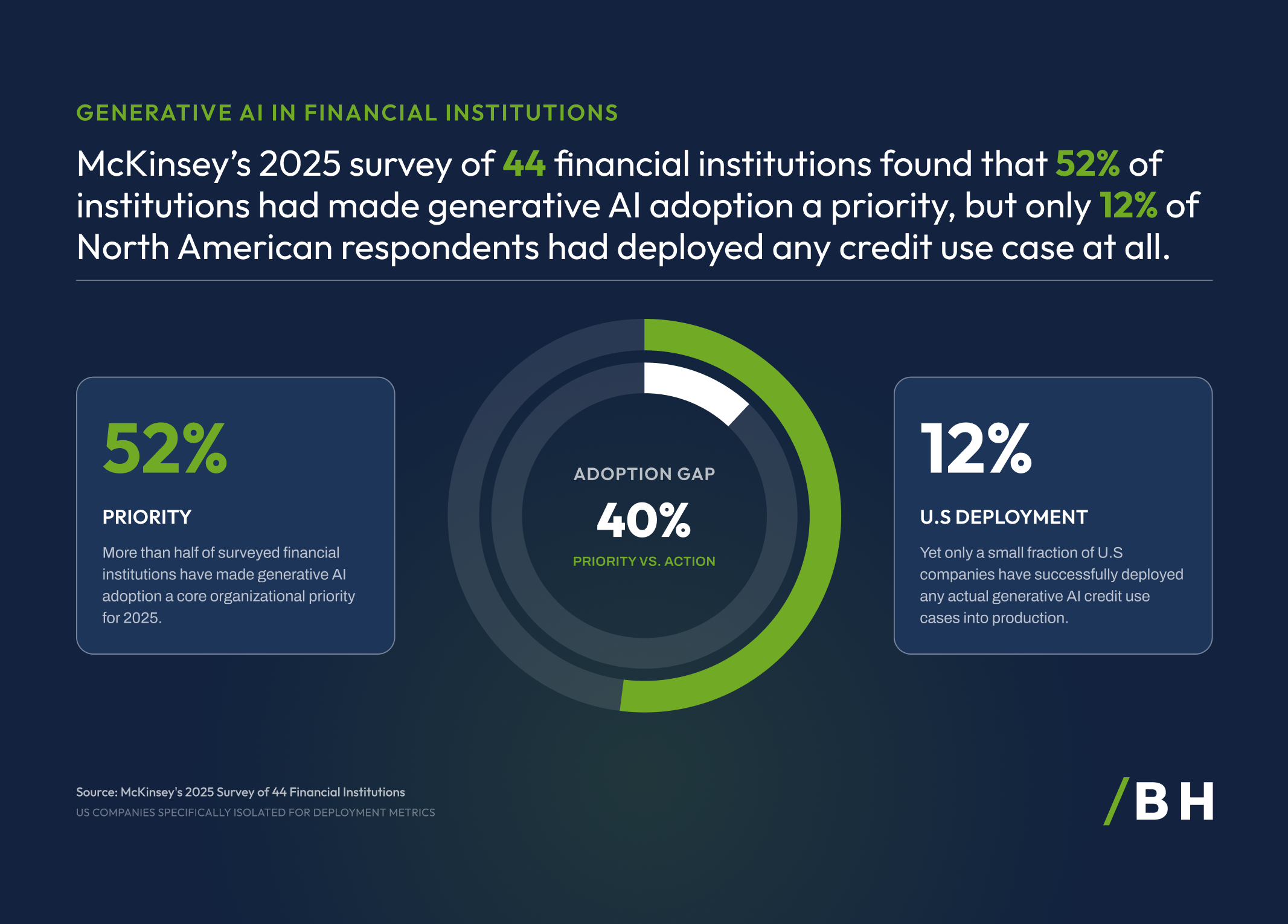
McKinsey’s 2025 survey of 44 financial institutions found that 52% of institutions had made generative AI adoption a priority, but only 12% of North American respondents had deployed any credit use case at all. McKinsey also found that more than two in five institutions had slowed use-case development because of disappointing outcomes, including insufficient accuracy and unclear benefits. Forty-one percent of survey respondents said model validation issues were holding them back.
That is not bankers being old-fashioned. That is bankers being bankers. Credit people do not trust magic. They trust evidence that the loan is going to be paid back.
McKinsey also notes that regulators are watching AI integration to ensure models are safely built, clearly explained, rigorously documented, and controlled. That is the bar, and it is the right bar.
A lender cannot walk into loan committee and say, “The model seemed confident.” A chief credit officer cannot defend a rating migration by pointing to a black box. A portfolio manager cannot act on an alert without understanding the driver.
If AI cannot show its work, it will not earn trust. And if AI simply restates what ratios already showed, only faster, then it has recreated the exact failure of elevator analysis: the appearance of sophistication without enough decision value.
Good AI Improves Insight, Not Just Speed
The practical case for AI in commercial lending is not “make everything instant.” That is conference-booth nonsense, and I see it way too many times as I talk to new vendors (and even some that have been around for a while).
The real case is better signal detection, better context, better prioritization, and better use of banker judgment.
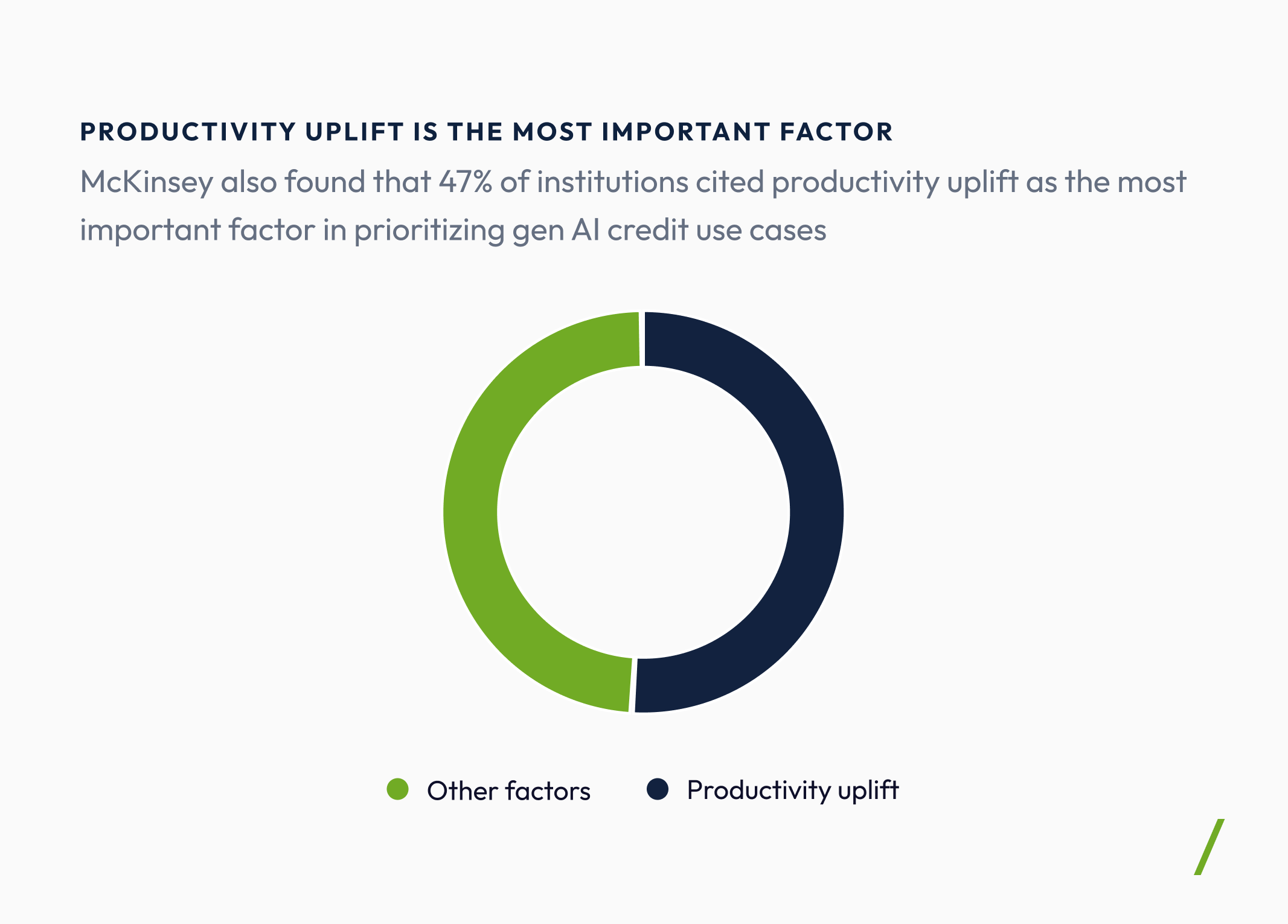
McKinsey says gen AI credit applications are gaining traction in areas such as early-warning systems, credit memo drafting, credit decisioning, pricing, and customer engagement. McKinsey also found that 47% of institutions cited productivity uplift as the most important factor in prioritizing gen AI credit use cases.
But productivity alone is not enough.
The goal is not to help bankers produce the same answer faster. The goal is to help them see more of the borrower, more of the relationship, and more of the portfolio.
Agentic AI in corporate credit says AI-driven agents can analyze large unstructured data sets, check data quality and consistency, conduct routine policy checks, and generate deeper comparisons across data sets, products, and processes. Here at Baker Hill, we also see that credit reviews that previously took days could move toward near real time when AI is embedded into end-to-end workflows.
That is useful. But the more important sentence is this one: properly built AI helps bankers make meaningful comparisons across data sets and generate deeper business insights.
That is where credit quality improves.
A strong AI-enabled lending process should help bankers understand why a borrower is changing, not simply what has changed, surface relationships that are hidden in the portfolio, and explain recommendations with transparency.
McKinsey also stated that, based on its experience guiding financial institutions through AI transformations, AI can create a 40% to 80% productivity uplift per use case, greater output consistency, and increased automation of control coverage.
Those are meaningful numbers. But again, the win is not just speed. The win is giving bankers more time to debate what matters most.
Good AI doesn’t replace judgement. It expands it.
That is what good AI should do. It should elevate judgment, not replace it. Not hide it. Elevate it.
Putting This Philosophy Into Practice
This is where Baker Hill’s approach is worth discussing.
The reason Baker Hill fits this argument is that its AI and automation story is tied to the actual lending workflow. Not a sidecar. Not a generic chatbot. Not a shiny demo that lives outside the credit process.
A ratio by itself tells you very little. A ratio tied to source data, borrower history, peer context, projections, covenants, workflow status, and portfolio monitoring tells you much more.
That is closer to the commercial lending future banks need. Our goal is to strengthen credit judgment, not replace it, with an emphasis on governance, traceability, human override, explainability, and surfacing risk earlier.
A commercial lending platform should not ask bankers to trust an unexplained answer. It should help them follow the evidence.
Baker Hill’s stronger story is not “AI makes lending faster,” although faster matters. The stronger story is this:
AI, when embedded in the lending lifecycle, turns scattered borrower information into decision-ready insight, with the banker still accountable for judgment.
The future of commercial lending will not be won by the bank with the flashiest AI summary. It will be won by the bank that sees risk sooner, sees opportunity more clearly, and puts its people where judgment matters.
That is not hype. That is just better banking.