.svg "logo (1)")









Rising costs, refinancing pressure and intensifying competition are making real-time visibility as important as the credit decision itself.
Construction lending has quietly become one of the most consequential lines on the bank balance sheet. It is the highest-yielding real estate exposure most institutions hold, while at the same time the most operationally intensive and expensive to administer, and the one where a portfolio's true condition is hardest to see in real time. Nearly every asset in the book is, by definition, unfinished. The value is contingent on work that has not yet happened, performed by third parties the lender does not control. You could say that there are a couple of plates spinning in the air.
That has always been true. What has changed is the environment around it: competition for capital is becoming more aggressive, costs are escalating unevenly, demand is concentrating in a narrow band of asset classes, and a refinancing wall is testing the exit assumptions embedded in loans underwritten two and three years ago.
For construction lenders, that changes the risk equation. Making the right credit decision at origination is only the starting point. The greater challenge is maintaining visibility into what changes after the commitment is made — project costs, inspections, documentation, draw activity and ultimately the assumptions supporting repayment.
The institutions that navigate the next 24 months well will be the ones that see those changes sooner and have the information to act on them.
The Starting Point: A Concentrated, Community-Held Book
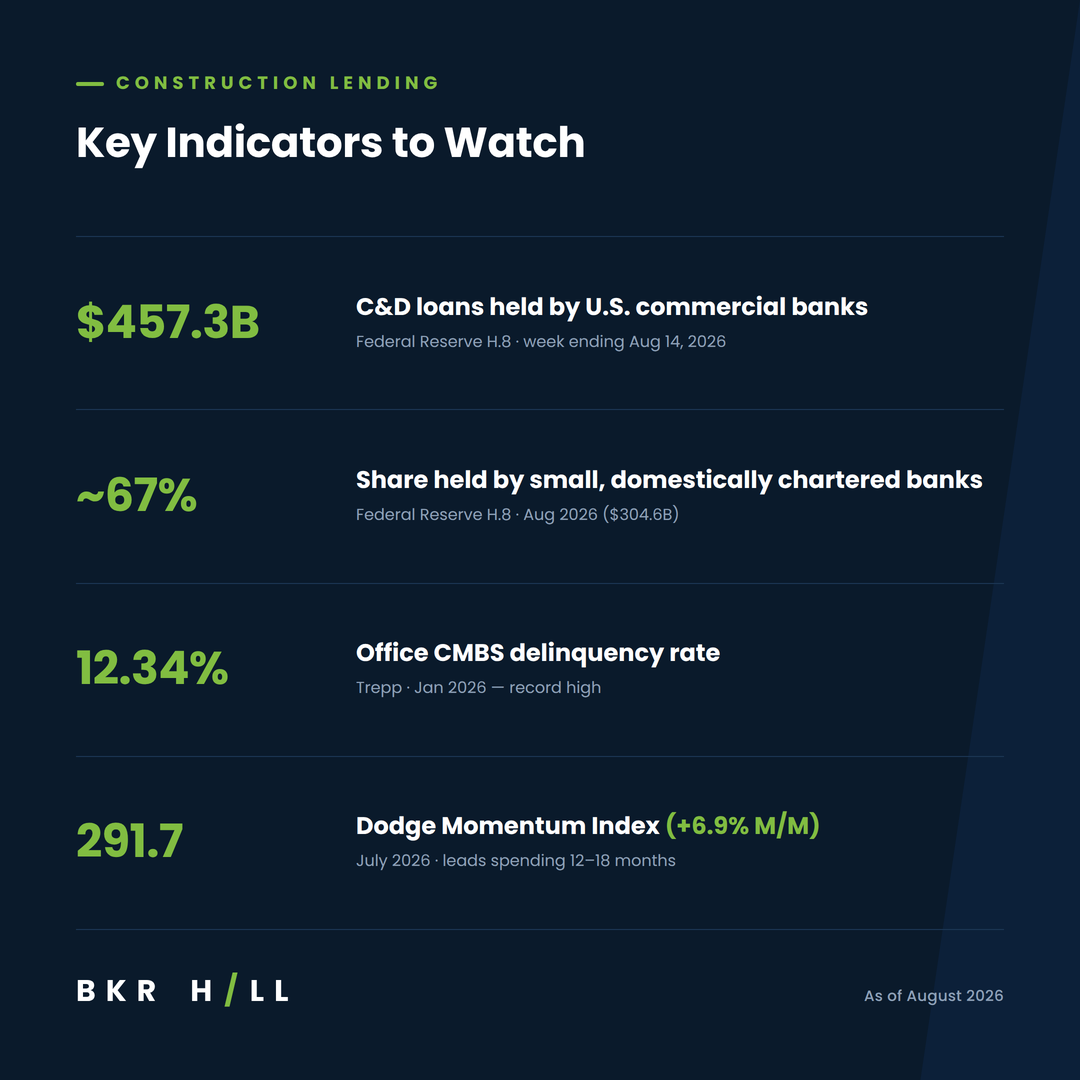
U.S. commercial banks hold around $457.3 billion in construction and land development loans as of the week ending August 14, 2026, according to the Federal Reserve's H.8 release. The more revealing figure is the distribution. Small domestically chartered commercial banks held roughly 67 percent of that balance. That is more than twice the exposure carried by large domestic institutions.
Construction lending is, in other words, a community and regional banking business. It is also the exposure that regulators watch most closely. The 2006 Interagency Guidance on CRE concentrations, which was restated verbatim in the FDIC's 2023 advisory and are still the active supervisory criteria, flags institutions where Construction and Development loans exceed 100 percent of Tier 1 capital plus allowance, total CRE exceeds 300 percent, or the CRE portfolio has grown more than 50 percent in 36 months. These are screening triggers, not caps. But crossing one moves the conversation from whether you can grow to whether you can demonstrate you are managing what you already have.
Five Trends Reshaping CRE Construction Lending
1. Demand is bifurcating, expanding, and contracting
It depends on where you look because the headlines seem contradictory, and that is the point. The Dodge Momentum Index, which leads nonresidential construction spending by 12 to 18 months, rose 6.9 percent in July 2026 to 291.7, near record territory. Yet the Federal Reserve's Senior Loan Officer Opinion Survey found a moderate net share of banks reporting weaker demand for construction and land development loans in the second quarter of 2026.
Both are accurate. Planning activity is being driven overwhelmingly by data centers and a handful of institutional megaprojects, deals largely financed by infrastructure funds, private credit, and the largest banks.
Meanwhile the bread-and-butter mid-market pipeline that most community banks underwrite — small industrial, retail, mixed-use, suburban multifamily — has thinned. A lender reading the aggregate index as a proxy for its own pipeline will mis-forecast badly.
2. The private credit premium is a pricing signal, not just a competitive threat
Over the past couple of quarters, the spread premium private credit commands over bank pricing reached 329 basis points, according to Gumption’s 2026 CRE Lending Report.
What stands out is that borrowers are demonstrably willing to pay more than 300 basis points for speed, certainty of execution, and flexibility on structure. That is a measurable price on operational capability. Banks that can shorten time-to-decision and time-to-draw are not merely improving efficiency ratios; they are competing directly against a premium the market has already quantified.
3. Cost volatility has migrated from a borrower problem to an underwriting problem
Baseline construction cost escalation is running 4 to 6 percent in 2026, with far sharper moves in specific inputs: copper wire and cable up 22 to 36 percent year over year, aluminum up 30 to 33 percent, driven substantially by tariff expansions. Labor is the other constraint, with an estimated 500,000 additional workers needed in 2026.
The consequence for lenders is that a budget approved at closing is a depreciating document. Contingency lines sized on assumptions are being consumed well before the end of the project. The question is no longer whether costs will rise, but whether the lender will detect budget drift while there is still contingency left to reallocate, or only discovers it at the final draw, when the only remaining options are an unbudgeted advance or a stalled project.
4. The construction-to-permanent handoff is now the riskiest moment in the deal
Bank-held CRE is materially healthier. The FDIC's 2026 Risk Review put the industry's CRE past-due and nonaccrual ratio at 1.45 percent. But the transmission mechanism runs through the exit. A construction loan is underwritten to a stabilized takeout that may no longer pencil at today's rates and today's debt yields.
Completion risk and refinancing risk, historically managed by separate teams on separate timelines, have converged into a single exposure that needs to be evaluated as one.
5. Supervisory focus is shifting from concentration levels to concentration management
The Senior Loan Officer Opinion Survey data through 2026 shows a genuine divergence: large banks modestly easing standards on construction and land development, smaller banks tightening. That divergence itself invites examiner attention. And the pattern in recent examinations is consistent. The finding is rarely that a bank's concentration is too high. It is that the bank cannot provide evidence, on demand, that it knows the current condition of the portfolio: budget-to-actual by project, inspection currency, lien waiver completeness, stress results at the loan level.
A concentration a bank can document, explain, and stress is a strategy. The same concentration tracked across spreadsheets, email approvals, and PDFs in shared folders is a finding waiting to be written.
What Construction Lenders Need in the Toolbox
Taken together, these trends point to a fundamental shift in construction lending: managing the loan after the commitment is becoming as important as making the right credit decision in the first place. The question is whether lenders have the visibility, controls and speed to respond as conditions change.
Here are some absolute must dos for Construction lenders:
- Measure the portfolio continuously, not quarterly. Construction risk is time-sensitive in a way that ordinary credit risk is not. A stale inspection or an unreconciled budget is not a documentation gap; it is an unmeasured exposure that compounds with every draw funded against it.
- Treat cycle time as a competitive instrument. If borrowers pay a 329-basis-point premium for certainty and speed, then draw cycle time is a pricing lever, not a back-office metric. Institutions on modern draw platforms report cycles compressing from multi-week email chains to days or even hours.
- Move controls from after-the-fact review to system-enforced checks. Duplicate invoices, costs billed ahead of work performed, and missing lien waivers are the recurring loss vectors in construction lending. They are detectable by system-enforced rules harder to identify consistently and efficiently through manual review at scale. I just spoke with a banker last week who was telling me about a nightmare scenario where they over-distributed the loan. Do not hurt yourself by having poor reviews in place.
- Close the gap between origination and administration. Origination, draw administration, and portfolio risk are usually three systems and three data sets. The exposure lives in the seams between them.
Modern Construction Lending Requires a Connected Approach
The answer isn't simply adding more technology to the construction lending process. It's connecting the right capabilities at the points where lenders need better information and greater control.
Modern construction lending should move institutions from fragmented information to connected workflows, periodic reviews to continuous visibility and manual processes to technology-assisted reviews that help surface potential issues earlier. The goal isn't to replace lender judgment. It's to give lenders better information sooner so they can apply that judgment where it matters most.
That is particularly important during the draw process, where speed and risk management have traditionally competed with one another. With the right technology and controls working together, lenders shouldn't have to choose between a better borrower experience and disciplined risk management. They can move faster while maintaining the oversight construction lending demands.
The Future Belongs to Lenders Who Can See More
The message for lenders isn't that construction lending has become too risky.
The message is that the cost of not knowing has become too high.
Banks rarely get into trouble because projects encounter challenges. Every project encounters challenges. Problems occur when lenders discover those challenges too late.
The institutions that outperform over the next several years will be the ones that combine strong credit discipline with real-time portfolio visibility. They'll identify issues earlier, respond faster, and provide better experiences for borrowers without sacrificing control.
That isn't just a technology advantage. It's a competitive advantage.
And in an increasingly competitive construction lending market, that difference may determine which institutions continue to grow profitably and which spend the next cycle reacting to surprises.